

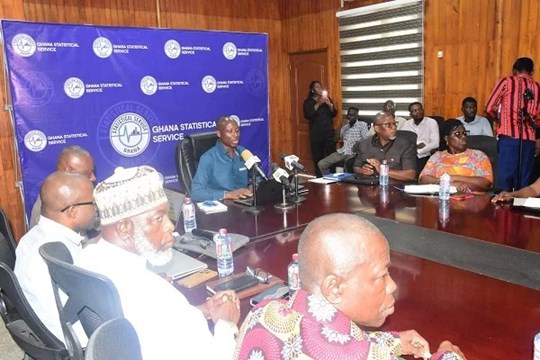
The country’s year-on-year inflation eased to 6.3 per cent in November from 8.0 per cent in October 2025, the lowest since price rebasing in 2021.
It also marked 11th consecutive months of decline in the rate of inflation.
On month-on-month basis, inflation rose to 0.9 per cent in November 2025 from –0.4 per cent in October 2025.
The Government Statistician, Dr Alhassan Iddrisu, who disclosed this in Accra yesterday when he released data on Ghana’s November Consumer Price Index (CPI) and inflation, said both food and non-food items drove the November disinflation.
Dr Iddrisu said that the November year-on-year rate of 6.3 per cent represented a substantial improvement from the 23.8 per cent recorded in November 2024, indicating a fall of 17.5 percentage points in less than a year.
The month-on-month inflation of 0.9 per cent, he said, showed a moderate rise in prices between October and November, consistent with the general easing of inflationary pressures observed throughout the year.
Dr Iddrisu said food inflation fell sharply to 6.6 per cent in November from 9.5 per cent in October.
However, Dr Iddrisu said food prices increased by 1.1 per cent on a month-on-month basis.
The Government Statistician said vegetables, tea, cooking bananas, potatoes and related items saw inflation fall from 44 per cent in February to 0.7 per cent in November, though their prices rose modestly between October and November.
He said cereals and cereal products also registered strong disinflation, with inflation easing from 26.6 per cent in May to 0.6 per cent in November.
“Meat inflation declined to 12.5 per cent, while ready-made foods, fish and seafood all recorded lower year-on-year inflation compared to earlier in the year,” Dr Iddrisu stated.
He said Nonfood inflation eased to 6.1 per cent in November from 6.9 per cent in October.
The Government indicated that month-on-month, nonfood prices rose marginally by 0.8 per cent.
The Government Statistician explained that services inflation fell to 3.8 per cent, with a slight monthly decline of 0.1 per cent.
He said inflation for locally produced items declined to 6.8 per cent, from 8.0 per cent while imported inflation dropped to 5.0 per cent in November from 7.8 per cent in October.
“This signals moderating domestic and external price pressures,” the Government Statistician said.
On regional inflation, Dr Iddrisu said the Northeast recorded the highest inflation at 12.2 per cent, while the Savannah Region posted the lowest at –0.02 per cent.
He said the top five regional contributors to national inflation were Greater Accra, Eastern, Ashanti, Central and Western, jointly accounting for more than three-quarters of the national rate.
Among a raft of recommendations, the Government Statistician urged the government to maintain fiscal discipline, focus resources on keeping food prices stable and work to reduce regional disparities by improving storage, irrigation and transport systems.
To businesses, Dr Iddrisu urged them to take advantage of lower inflation to invest in efficiency, strengthen local supply chains, reduce waste and pass cost savings to consumers where possible.
The Government Statistician advised households of falling inflation to budget more intentionally, avoid unnecessary spending and save whenever they could.
Source: Ghanaian Times





Leave a Comment